

I’ve loved animals ever since I knew what they were. As a child, I had a guinea pig, a rabbit, three cats and a dog. I always imagined myself becoming either a teacher or a veterinary nurse. Once I left secondary school, I started studying to be a teacher, but realised I didn’t enjoy it enough halfway through my degree and switched to a veterinary nursing course.

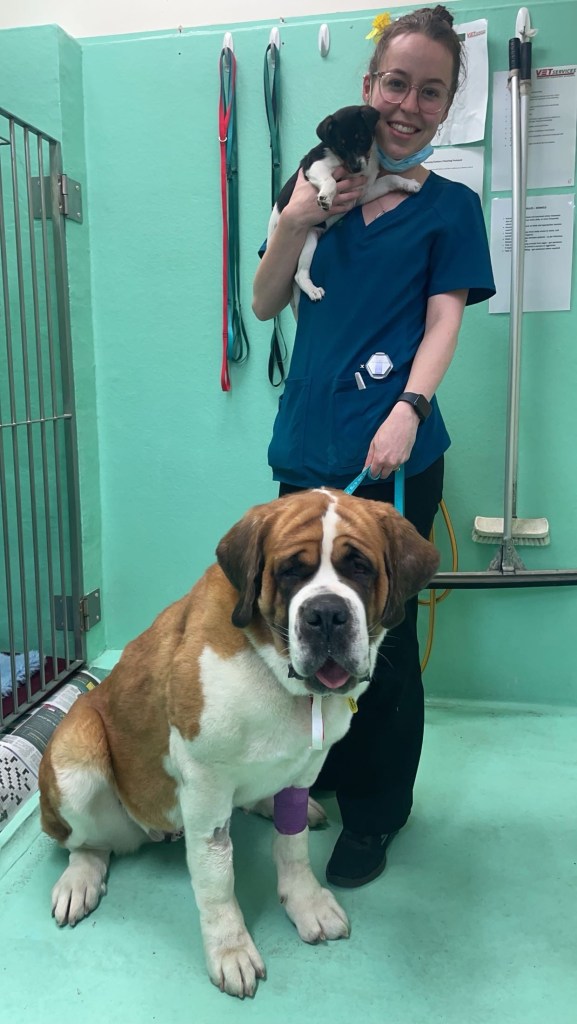
In 2021, I began studying to become a veterinary nurse. I loved the study, and was fascinated by the anatomy and physiology and nursing techniques. Although I started working as a nurse at the end of 2021, I graduated in 2023, and then became a registered veterinary nurse.


I started my career absolutely loving my job. I adored nursing animals back to health, conducting nurse clinics, managing hospital wards, carrying out diagnostic tests and monitoring surgical procedures. I saw so many interesting cases and cared for a huge variety of animals and wildlife, including a kiwi, fawns, hawks, lambs, a goat, a turtle, a hedgehog, birds, wild cats, stray dogs, rabbits and guinea pigs, as well as the standard cats and dogs.
I nursed hundreds of animals, assisted with surgeries, took X-rays, placed splint bandages, assisted with physical rehabilitation and physiotherapy, and even assisted with acupuncture and dental procedures. There was always something new to learn. And for all of the sick patients I saw, I also got to see plenty of happy, healthy animals — from routine vaccinations and health checks to puppies and kittens coming in for their first visits.
For all of the highs, there were unfortunately many lows. I saw animals being mistreated and abused, owners unable to afford treatment that could have saved their animal, and animals deteriorating because owners didn’t follow aftercare advice. I pulled muscles and damaged my back lifting heavy dogs, got scratched by feral cats badly enough to require treatment at A&E, was bitten numerous times, and once had to chase a runaway dog across town on foot.
Obviously, part of the job is assisting with euthanasia, as well as supporting owners through one of the most difficult experiences of their lives. When you’re doing this day in and day out, you do become desensitised to it to an extent, but that doesn’t mean it isn’t emotionally taxing. Having to go directly from assisting with a euthanasia to vaccinating a litter of excited puppies isn’t easy.
Compassion fatigue is a recognised issue within the profession and is even taught as part of veterinary nursing education. It is the profound physical, emotional and psychological exhaustion that can come from continuously caring for others who are in distress, pain or suffering. Often called the “cost of caring”, it occurs when a caregiver takes on the emotional burden of their patients or clients, eventually eroding their own ability to feel empathy and compassion.
Sadly, workplace culture amongst veterinary professionals isn’t always great, which I unfortunately experienced. The mental-health statistics within veterinary medicine are particularly concerning. Research across multiple countries has consistently found that veterinary professionals are two to five times more likely to commit suicide than the general public. Veterinary nursing also has high rates of burnout, compassion fatigue and people leaving the profession within the first few years.
A key study on Stress and Compassion Fatigue in NZ Vet Nurses revealed that an astonishing 94% of Kiwi vet nurses reported feeling highly stressed, while 82% experienced chronic compassion fatigue. These statistics are particularly concerning when you consider the physical and emotional demands of the job, alongside relatively low wages and staff shortages.


I found my time as a veterinary nurse to be interesting, inspiring, fulfilling, draining, depressing and emotionally damaging. Unfortunately, the general public doesn’t always understand the difficulties of the profession, and there is a common perception that vets are in it for the money. The reality is quite different. Veterinary medicine is generally far less financially rewarding than human medicine, despite veterinarians undergoing extensive medical training and carrying enormous clinical responsibility.
The difference between doctors and veterinarians is particularly noticeable in New Zealand. Veterinarians currently earn around $92,000–$163,000 a year, depending on experience and position. By comparison, experienced medical specialists in New Zealand can earn well over $200,000, with senior medical officers earning substantially more again. This disparity isn’t unique to New Zealand either. Internationally, doctors are consistently among the highest-paid healthcare professionals, with OECD data showing that GPs and medical specialists generally earn significantly more than the average national wage.
Veterinarians, of course, are not doctors of human medicine, and the two professions aren’t perfectly comparable. They have different training systems, employment structures, specialties and responsibilities. But both are medical professions requiring extensive scientific knowledge, clinical decision-making and the ability to make life-or-death decisions. Despite this, veterinary medicine is generally much less financially rewarding.
The disparity becomes even more striking when comparing nurses with veterinary nurses. In New Zealand, registered human nurses covered by the national nursing pay-equity settlement have a top base rate of $99,630 per year, while senior nurses and nurse practitioners can reach $153,060 per year. By comparison, the NZVNA’s 2026 recommended hourly rate for a new veterinary nursing graduate is $28.75–$30.55 an hour (approximately $59,800–$63,500 per year based on a 40-hour week). The NZVNA’s 2025 remuneration survey found that veterinary nurses and nursing assistants actually averaged $29.38 an hour (approximately $61,100 per year), while senior veterinary nurses averaged $33.07 an hour (approximately $68,800 per year). Despite this, there are many reports that plenty of clinics are still paying nurses $24-26 an hour, regardless of their experience, as they are privately owned and the NZVNA wage guidelines are just that, guidelines, not requirements.
That means that two people can both be registered nurses, administering medication, caring for critically ill patients, assisting with surgery and supporting distressed patients and their families (and veterinary nurses actually being anaesthetists) — yet the veterinary nurse can earn dramatically less simply because their patients have fur instead of skin.
I don’t think veterinary nurses should be paid the same as human nurses simply because the job titles are similar; the professions are different and require different qualifications. But the scale of the disparity does raise questions about how veterinary nursing is valued. The NZVNA itself acknowledges that veterinary nurses have historically been poorly paid and says that appropriate remuneration is essential for workforce sustainability, wellbeing and retention.
And the low pay is particularly difficult to reconcile with what veterinary nurses actually do. As a veterinary nurse, you are an anaesthetist, surgical nurse, hospital nurse, animal behavioural handler, orthopaedic nurse, radiology technician, phlebotomist, laboratory technician, pharmacy technician, first responder, emergency nurse, isolation specialist, stock controller, procurement officer, cleaner, receptionist and emotional support worker all rolled into one. You can be responsible for monitoring an anaesthetic, placing IV catheters, administering medication, collecting blood, running laboratory tests, assisting with surgery, monitoring critically ill patients and managing hospital wards — sometimes all within the same shift.
Weekend work is standard practice, with some nurses working every second weekend. Often times this involves one nurse and one vet being rostered, with no telling how busy the day will be and the number of patients that may need to be seen. I once worked a weekend where we had three emergencies come in at the same time, and I was the only nurse working. Although dedicated emergency clinics are becoming more common, after-hours work is still part of many veterinary nurses’ roles. If an emergency comes in at 2am and surgery is required, you will be called in to assist — and still be expected to turn up for your normal shift at 8am the following morning. The long hours, disrupted sleep and lack of recovery time can contribute significantly to exhaustion and burnout.
There is also a huge amount of unseen physical and emotional labour. Animals cannot tell you what hurts, and they don’t always cooperate with treatment. A frightened, thrashing dog can weigh 40 kilograms, while even a small cat can cause serious injuries when terrified. You spend much of your shift on your feet, lifting and restraining animals, cleaning kennels, dealing with bodily fluids and managing emergencies.
But you are also caring for the people attached to those animals. You support owners through frightening diagnoses, financial decisions and the loss of beloved family members. Sometimes you have to watch an animal deteriorate and eventually be put to sleep simply because its owner cannot continue to afford the treatment it needs.
You learn to compartmentalise because you have to. When you perform euthanasia regularly, you inevitably become somewhat desensitised to it, but that doesn’t mean it isn’t emotionally taxing. Compassion fatigue is a recognised problem within veterinary nursing and veterinary medicine. It is the physical, emotional and psychological exhaustion that can come from continually caring for others who are suffering — often described as the “cost of caring.”


Veterinary nursing is therefore not simply a job where you get to cuddle animals all day. It is a highly skilled clinical profession that combines medicine, nursing, surgery, anaesthesia, emergency care, laboratory work, animal behaviour, physical labour and emotional support. It is incredibly rewarding, but it can also be physically exhausting, emotionally devastating and financially difficult to sustain.
For me, that contradiction ultimately became impossible to ignore. I loved the animals, I loved the medicine and I loved being able to make a difference, but loving the work did not make the low wages, physical injuries, emotional exhaustion and difficult workplace experiences disappear. Although I really enjoyed most of my career, it eventually became too draining to continue while still being able to live the life I wanted.
I will always remember my time as a veterinary nurse fondly — for the animals I fell in love with and cared for, the friends I made, the experiences I had and the knowledge I gained. It taught me an enormous amount, both professionally and personally, and I will always be grateful that I had the opportunity to do it. But sometimes loving a career isn’t enough to make it sustainable, and for me, it is time to move on to a new challenge that is more supportive of my long-term physical and mental health.